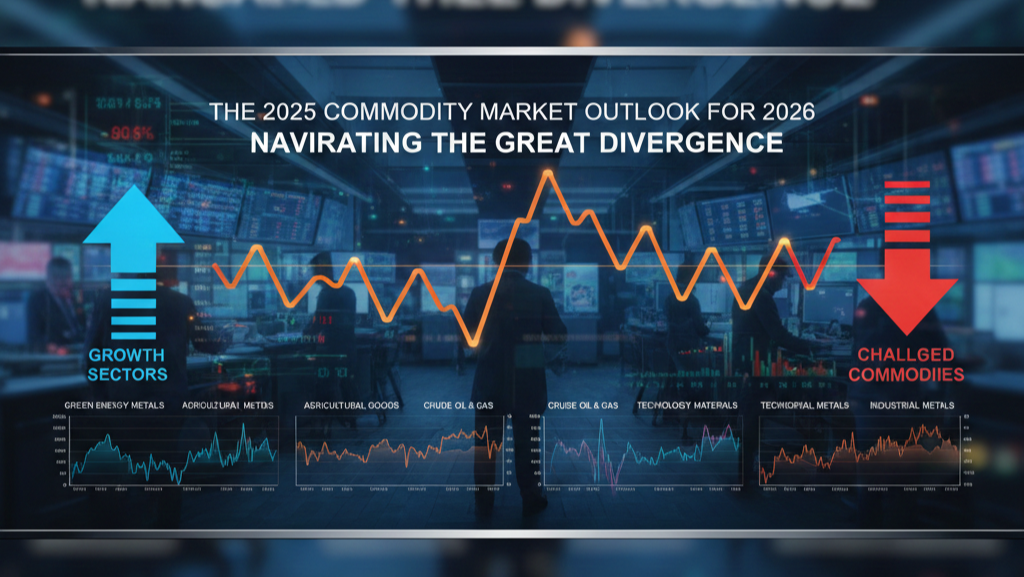
The global commodity market serves as the material foundation of our entire economy, governing the flow of everything from the oil that powers our transport to the wheat that feeds our families. As we move deeper into 2025 and look toward 2026, this vast ecosystem is undergoing a profound transformation. We are no longer witnessing a synchronized “supercycle” where all prices rise together. Instead, the market has fractured into a narrative of extreme divergence. While energy markets are cooling due to structural surpluses, industrial metals are heating up, driven by critical shortages in the face of the artificial intelligence and green energy booms.
Understanding these shifting sands is crucial for anyone looking to navigate the financial landscape of the mid-2020s. The commodity market is currently being pulled in opposing directions by powerful macroeconomic forces. On one side, the deceleration of traditional industrial growth in China is capping demand for fossil fuels. On the other, the insatiable appetite for electrification and computing power is creating historic deficits in specific mineral sectors. This report condenses extensive research into a clear, actionable guide on the trends, risks, and opportunities defining the market today.
The Macroeconomic Backdrop: A Tale of Two Economies
The performance of raw materials in 2025 is inextricably linked to a broader economic slowdown and a reshaping of global demand. The International Monetary Fund (IMF) and other major institutions have noted a softening in global growth, but the real story lies in the composition of that growth. For decades, China’s rapid urbanization and infrastructure spending acted as the primary engine for all commodities. Today, that engine is pivoting.
China is transitioning from an economy built on concrete and steel to one driven by high-tech manufacturing and “New Productive Forces” like electric vehicles (EVs) and renewable energy grids. This shift has created a decoupling effect. The demand for materials used in traditional construction is stagnating, while the consumption of energy transition metals is accelerating. Simultaneously, the resilience of the US economy and a projected lowering of interest rates in 2026 are providing a floor for prices, making non-yielding assets like gold more attractive relative to bonds.
Industrial Metals: The Copper Crunch and AI Demand
The most compelling bullish case in the current market belongs to copper. Often called “Dr. Copper” for its ability to diagnose economic health, this metal is facing a supply crisis just as demand enters a new phase of intensity. Analysts from J.P. Morgan and the International Copper Study Group (ICSG) project that the market will flip from a balanced state in 2025 to a deep structural deficit by 2026.
This impending shortage is driven by two main factors. First, the supply pipeline is running dry. Mine production growth is forecasted to collapse to a mere 1.4% in 2026 due to underinvestment, declining ore grades in Chile and Peru, and operational disruptions. Second, demand is exploding from a new source: Artificial Intelligence. AI data centers are incredibly power-intensive, requiring massive amounts of copper for cooling systems and power distribution. Estimates suggest data centers alone could add nearly half a million tons of new copper demand by 2026. As a result, price forecasts for the red metal are aggressive, with projections averaging over $12,000 per metric ton next year as buyers scramble to secure reliable supply.
Energy Markets: The Looming Era of Surplus
In stark contrast to the metals sector, the energy complex is facing a bearish future defined by abundance. The prevailing narrative for crude oil has shifted from scarcity to surplus. The World Bank forecasts a sustained decline in oil prices, projecting Brent crude to fall to an average of $68 per barrel in 2025 and potentially hit a five-year low of $60 by 2026.
This downward pressure is the result of a flood of new supply from outside the OPEC+ cartel. Producers in the United States, Brazil, Guyana, and Canada have ramped up output significantly, eroding OPEC’s ability to control prices. This “non-OPEC+ surge” is overwhelming global demand, which is simultaneously being eroded by efficiency gains and the electrification of transport. In China, the rapid adoption of EVs is permanently destroying demand for gasoline. Consequently, the world is facing a potential oil glut in 2026 that could exceed the surplus seen during the 2020 pandemic, fundamentally altering the inflationary landscape.
Precious Metals: Safe Havens and Tax Traps
Gold and silver continue to shine as safe-haven assets in an era of geopolitical fragmentation. In late 2025, prices have been supported by aggressive central bank buying, particularly from emerging markets looking to diversify reserves away from the US dollar. As real interest rates in the West begin to decline, the opportunity cost of holding gold decreases, further fueling investment demand.
However, retail investors in the United States must be wary of the tax implications inherent in this sector. The IRS classifies gold, silver, and other precious metals as “collectibles” rather than capital assets. This means that long-term gains on physical bullion—and even on many physically-backed ETFs—are taxed at a maximum rate of 28%, significantly higher than the standard 15% or 20% capital gains rate applied to stocks. Sophisticated traders sometimes utilize futures contracts to navigate this, as they can qualify for a blended 60/40 tax treatment, but for the average buy-and-hold investor, the “collectibles” tax bite is a critical factor to consider in net return calculations.
Agricultural Commodities: Weathering the La Niña Storm
While metals and energy follow secular trends, agricultural markets remain at the mercy of the weather. The dominant force for 2025 and 2026 is the La Niña climate phenomenon, which is creating a patchwork of winners and losers across the globe. La Niña typically cools the surface waters of the Pacific, leading to dryness in the Americas and heavy rainfall in Southeast Asia.
This weather pattern is creating divergence within the coffee market. Brazil, the world’s largest producer of premium Arabica beans, is seeing favorable conditions that could boost yields and soften prices. Conversely, Vietnam, the top producer of Robusta beans used in instant coffee, faces the risk of excessive rains disrupting harvest logistics. Meanwhile, the cocoa market remains in crisis mode. After prices surged to record highs in 2024 due to disease and aging trees in West Africa, there is cautious optimism that La Niña’s moisture could aid crop recovery in 2026, potentially offering some relief to chocolate manufacturers and consumers alike.
The Financialization of Raw Materials
The way investors access the commodity market is evolving rapidly. For years, Exchange-Traded Funds (ETFs) were the primary vehicle for retail exposure. However, investors must understand the structure of these funds. Futures-based ETFs do not own the physical commodity; they own contracts. This exposes them to “roll yield” risk. When a market is in contango (future prices are higher than spot prices), the fund loses money every month by selling cheap expiring contracts to buy expensive new ones. This structural drag can cause these funds to severely underperform the spot price of the commodity over time.
A new trend gaining traction is the tokenization of Real-World Assets (RWA) on the blockchain. By late 2025, billions of dollars in commodities like gold had been tokenized. These digital tokens represent fractional ownership of physical metal stored in vaults but offer the ability to trade 24/7 with near-instant settlement. While this innovation solves liquidity issues and allows for easier transfer of ownership, it introduces new regulatory and technical risks that investors must navigate carefully compared to the established protections of traditional equity markets.
Navigating Risks and Fraud
The allure of high commodity prices often attracts sophisticated fraudsters. Regulatory bodies have issued stern warnings regarding investment scams targeting retail participants. One prevalent threat is the “pig butchering” scam, where fraudsters build long-term trust with victims online before convincing them to invest in fake commodity or crypto platforms.
In the physical metals space, investors should be vigilant against “numismatic fraud.” Unscrupulous dealers often sell “rare” or “collectible” coins at markups of 40% to 200% above the melt value of the gold, claiming they offer special investment potential. In reality, these coins are often worth only their metal content, leading to immediate and unrecoverable losses for the buyer. Verifying dealer registration with the Commodity Futures Trading Commission (CFTC) and sticking to standard bullion products are essential defensive steps.
Conclusion: Strategy for a Divergent Future
The outlook for the commodity market in 2026 is not a singular story of boom or bust, but rather a narrative of specific opportunities and structural risks. The era of passive commodity indexing—buying a basket of everything and hoping it goes up—is likely over. The market is rewarding specificity. The smart money is looking long at the materials essential for the energy transition, like copper, while remaining cautious on fossil fuels facing a structural glut.
For the individual investor, success requires looking beyond the headlines. It demands an understanding of the tax inefficiencies of gold, the weather risks in agriculture, and the supply cliffs in industrial metals. It also requires a high degree of skepticism toward guaranteed returns and high-pressure sales tactics. As the global economy re-engineers itself around new technologies and energy sources, commodities will remain the ultimate arbiter of value, rewarding those who can distinguish between the assets of the past and the inputs of the future.
References
This article is based on extensive market analysis and data from leading financial and intergovernmental organizations. For further reading and verification of the trends discussed, you can consult the following authoritative sources:
The International Monetary Fund (IMF) World Economic Outlook: Offers broad macroeconomic data and insights into how global growth impacts commodity consumption. ((https://www.imf.org/en/Publications/WEO))
The Commodity Futures Trading Commission (CFTC): A primary resource for checking the registration status of brokers and learning about fraud prevention in commodity markets. (https://www.cftc.gov)
The International Copper Study Group (ICSG): The leading authority on global copper supply, demand, and mine production statistics. (https://www.icsg.org)