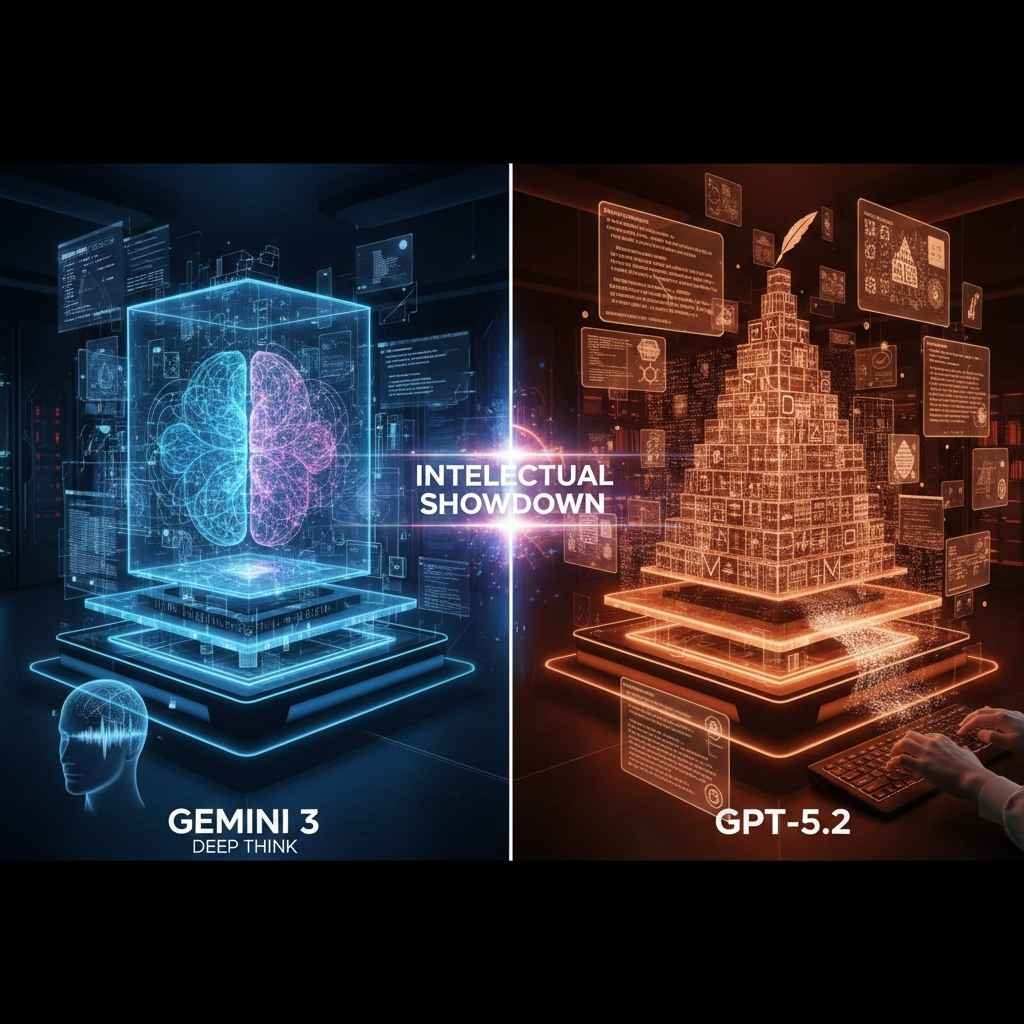
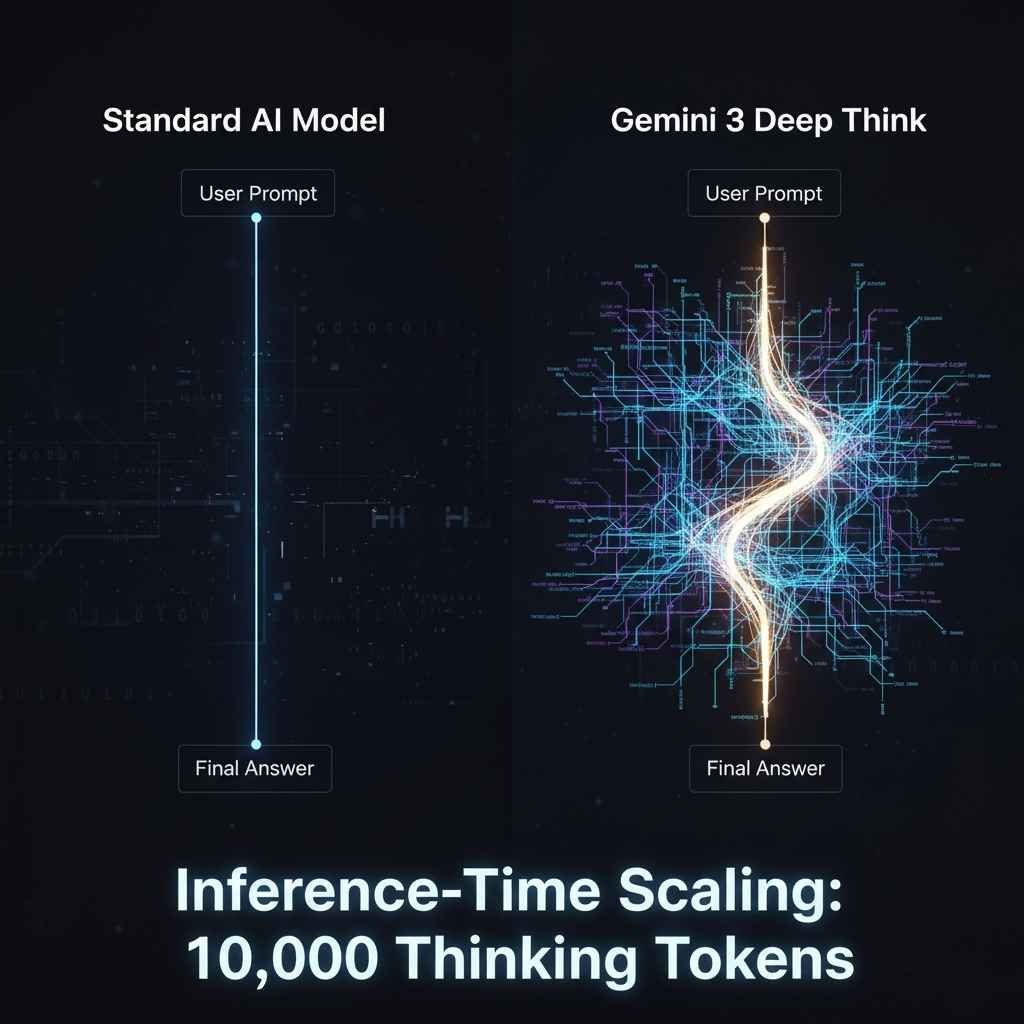
It pits the two major models against each other and introduces the buzzword “Inference-Time Scaling,” which is the central technical breakthrough
The Era of Inference-Time Scaling: A Technical and Strategic Analysis of Gemini 3 Deep Think Architecture
1. Introduction: The Paradigm Shift to System 2 AI
The release of the Gemini 3 model family on December 17, 2025, marks a watershed moment in the trajectory of artificial intelligence, signifying a decisive move away from the era of pure scaling laws and into the age of inference-time compute.1 For the past decade, the dominant dogma in Large Language Model (LLM) development was governed by the Kaplan scaling laws, which posited that performance improvements were primarily a function of increasing parameter counts, training dataset size, and training compute. However, the introduction of Gemini 3, and specifically its “Deep Think” capability, operationalizes a new scaling dimension: the ability of a model to “think” before it speaks, allocating variable computational resources at runtime to solve complex problems.3
This shift is not merely an incremental update; it represents the industrialization of “System 2” thinking in AI—a cognitive analogy drawn from Daniel Kahneman’s framework distinguishing between fast, instinctive reactions (System 1) and slow, deliberative reasoning (System 2). Gemini 3 Deep Think is designed to pause, generate internal thought traces, explore parallel hypotheses, and verify its own logic before emitting a final response to the user.4 This architecture addresses the fundamental limitations of previous transformer-based models, which were bound by sequential, token-by-token generation that often led to cascading errors in multi-step reasoning tasks.
The strategic context of this release is equally critical. Occurring amidst an intensifying rivalry with OpenAI, the launch of Gemini 3 triggered an internal “Code Red” at the competitor, precipitating the rapid release of GPT-5.2.6 This reactionary dynamic underscores the magnitude of the leap Gemini 3 represents, particularly in its ability to integrate this deep reasoning capability natively across multimodal inputs—text, image, audio, video, and code—within a unified ecosystem that spans from the mobile Android interface to the enterprise-grade Vertex AI platform.8
This report provides an exhaustive technical and strategic analysis of the Gemini 3 ecosystem. It dissects the “Deep Think” architecture and its reliance on parallel reasoning and reinforcement learning; it evaluates the model’s performance against the new rigorous standard of benchmarks like “Humanity’s Last Exam” and DeepSearchQA; it analyzes the economic transformation introduced by “thinking tokens”; and it explores the radical shift in developer workflows heralded by the Google Antigravity platform. By synthesizing technical specifications, benchmark data, and qualitative user feedback, this document aims to provide a definitive record of the state of the art in generative AI as of late 2025.
2. Architectural Foundations: The Mechanics of Deep Think
The core innovation of Gemini 3 is not simply that it is “larger” than its predecessors, but that it changes how the model processes information. The transition from immediate token generation to deferred, deliberative generation requires a fundamental re-architecture of the inference process.
2.1 Inference-Time Scaling and Thinking Tokens
The central thesis of Gemini 3’s architecture is that accurate reasoning on complex tasks requires “test-time compute.” In traditional models, the computational cost of a query was fixed per output token. Whether asking for a poem or a mathematical proof, the model expended roughly the same amount of compute per word generated. Gemini 3 Deep Think breaks this symmetry by introducing “Thinking Tokens”.9
These thinking tokens are latent constructs—hidden from the final output but visible in the system’s resource usage—that represent the model’s internal monologue. When a user submits a query, the model effectively “talks to itself,” generating a chain of thought that breaks down the problem, identifies constraints, and plans a solution path.5 The volume of these thinking tokens is dynamic; the model utilizes an adaptive mechanism to modulate its thinking budget based on the complexity of the prompt.1 A trivial query might trigger zero to few thinking tokens, while a complex request to “vibe code a retro videogame” or solve a Tier 1 FrontierMath problem might trigger thousands of tokens of internal deliberation.9
This mechanism creates a new “inference-time scaling law.” Research released alongside the model demonstrates that performance on reasoning tasks scales logarithmically with the amount of test-time compute (thinking time) allocated.11 By allowing the model to “think” longer, accuracy on benchmarks like DeepSearchQA improves significantly, mirroring the benefits previously seen only by retraining models on larger datasets.
2.2 Parallel Reasoning vs. Sequential Chain-of-Thought
While earlier models utilized Chain-of-Thought (CoT) prompting to improve reasoning, they were largely constrained to a single, linear narrative. If the model made a logic error in step 2 of a 10-step process, the error would cascade, irretrievably corrupting the final result. Gemini 3 Deep Think employs advanced parallel reasoning, a technique likely derived from research into Monte Carlo Tree Search (MCTS) and “Tree of Thoughts” methodologies.3
Instead of pursuing a single line of reasoning, Gemini 3 Deep Think explores multiple hypotheses simultaneously. It branches its internal thought process, effectively simulating different futures or solution paths.5
Hypothesis Generation: The model generates several potential approaches to a problem.
Evaluation and Pruning: It evaluates the promise of these paths, pruning those that lead to contradictions or dead ends.
Synthesis: The final output is constructed from the most robust reasoning trajectory.
This “branching” capability is crucial for tasks like coding or mathematical proofs, where a single syntax error or logical fallacy can invalidate the entire output. The “Inference Time Scaling” data provided in the Deep Research technical report highlights this, showing that “pass@N” strategies (generating N solutions and verifying them) are internalized within the Deep Think process, delivering the efficacy of multi-shot generation in a single user interaction.11
2.3 Reinforcement Learning on Reasoning Traces
The capability to “think” is not emergent solely from raw data but is cultivated through specialized training regimes. Gemini 3 utilizes Reinforcement Learning from Human Feedback (RLHF) and, more importantly, Reinforcement Learning on Reasoning Traces.12
The model is rewarded not just for the correctness of the final answer, but for the validity and coherence of the reasoning steps that led to it. This aligns the model’s internal “thought process” with human logical standards, reducing the “hallucination of logic” where a model might arrive at the right answer for the wrong reasons—or, more dangerously, use convincing-sounding logic to justify a false conclusion. The Hallucination penalty loss function specifically penalizes the model for citing non-existent sources or making ungrounded claims during the thinking phase, a feature critical for the reliability of the Deep Research agent.13
3. The Gemini 3 Model Family: A Stratified Ecosystem
Google has moved away from a “one model fits all” approach, diversifying the Gemini 3 family to address specific points on the cost-latency-intelligence curve. This stratification allows developers and enterprises to optimize their deployments based on the specific constraints of their use cases.
3.1 Gemini 3 Pro: The Frontier Flagship
Gemini 3 Pro is the apex of the family, designed for “frontier performance” and optimized for the most demanding intellectual tasks.2
Context Window: The model boasts a massive 1 million token context window, allowing it to ingest and reason over vast amounts of information—equivalent to hours of video or thousands of pages of text.12 This “infinite memory” capability allows for tasks that were previously impossible, such as analyzing an entire repository of code to perform a complex refactor or summarizing a full day’s worth of financial filings.14
Multimodality: Unlike competitors that often rely on stitching together separate vision and text models, Gemini 3 Pro is natively multimodal. It was trained from the start on text, images, audio, and video.12 This allows for “high frame rate understanding,” enabling the model to analyze video at 10 frames per second to capture rapid motions (like a golf swing) that other models would miss due to undersampling.15
Deep Think Integration: Gemini 3 Pro is the primary engine for the Deep Think mode. When users select “Deep Think” in the Gemini Advanced interface, they are engaging a specialized inference path of the Pro model.2
3.2 Gemini 3 Flash: Democratizing Reasoning
Perhaps the most disruptive element of the release is Gemini 3 Flash. Historically, “Flash” or “Turbo” models were distilled, “dumber” versions of the flagship. Gemini 3 Flash breaks this mold by incorporating the reasoning architecture of the Pro model but optimizing it for speed and extreme efficiency.1
Cost-Effective Intelligence: Gemini 3 Flash offers “Pro-grade reasoning” at a fraction of the cost—approximately one-quarter the price of the Pro model.16
Thinking Modulation: The Flash model features a highly efficient implementation of the thinking mechanism. It is able to “modulate how much it thinks,” using 30% fewer tokens on average than Gemini 2.5 Pro for similar tasks.1 It essentially acts as a hybrid: for simple queries, it responds instantly (System 1); for complex queries, it engages a lightweight version of the Deep Think process (System 2).
Market Impact: This model threatens to commoditize “intelligence.” By offering high-level reasoning capabilities at a price point accessible for high-volume consumer applications, Google is raising the baseline expectation for “standard” AI interactions.17
3.3 Ancillary Capabilities: Nano Banana and Veo
The ecosystem is bolstered by specialized models that handle generation tasks where pure reasoning models might struggle.
Nano Banana Pro: This curiously named model is a specialized image generation and editing engine. It offers “studio-quality levels of precision and control,” specifically designed for tasks requiring fine-grained visual manipulation.18 It is integrated into the Gemini workflow, allowing users to “create presentations” or perform “vibe coding” that results in visual assets.19
Veo 3.1 Fast: This is a video generation model available to Ultra subscribers. It prioritizes speed, allowing for the rapid prototyping of video content.21 Its inclusion highlights Google’s strategy of offering a “full stack” media generation suite within the Gemini interface.
4. Computational Economics: The Price of Thought
The shift to inference-time compute introduces a new economic variable: the cost of thinking. The pricing structure for Gemini 3 reflects this complexity, moving beyond simple input/output metering to a model where “thought” is a billable commodity.
4.1 The Split Pricing Model
Google has structured the pricing to incentivize the use of the Flash model while reserving the Pro model for high-value tasks.
Model
Input Cost (per 1M tokens)
Output Cost (per 1M tokens)
Context Caching
Gemini 3 Pro (<= 200k)
$2.00
$12.00
$0.20
Gemini 3 Pro (> 200k)
$4.00
$18.00
$0.40
Gemini 3 Flash
$0.50
$3.00
$0.05
Table 1: Pricing structure for Gemini 3 API.16 Note that “Thinking Tokens” are billed as Output Tokens.
4.2 The Economics of Thinking Tokens
Crucially, thinking tokens are billed at the output token rate.22 This has profound implications for developers.
Cost Variance: A simple prompt (10 tokens) could generate a massive bill if it triggers a deep reasoning trace (10,000 thinking tokens). The cost of a query is no longer predictable solely by the length of the user’s input or the desired answer length.
The Multiplier Effect: Because thinking tokens are billed as output (which is typically 3-4x more expensive than input), “Deep Think” queries are significantly more expensive than standard queries. This makes the thinking budget parameter in the API essential for cost control.9
Flash as the Workhorse: The significant price delta ($3.00 vs $12.00 for output) makes Gemini 3 Flash the obvious choice for scaled agentic workflows. An autonomous agent that runs 24/7, constantly “thinking” and planning, would be cost-prohibitive on Pro but viable on Flash.16
4.3 Enterprise and Batch Pricing
For large-scale enterprise deployments, Google offers a Batch API that provides a 50% discount on costs.22 This is strategically targeted at the “Antigravity” use case—running thousands of unit test refactors or deep research tasks overnight. The “Enterprise Tier” via Vertex AI also offers “provisioned throughput,” allowing corporations to buy dedicated compute capacity to smooth out the latency spikes inherent in variable thinking times.22
5. Benchmarking and Performance: A New Standard
The release of Gemini 3 has coincided with—and arguably necessitated—the retirement of older benchmarks like MMLU, which had become saturated. Google and the broader AI community have shifted to “frontier” benchmarks designed to test genuine fluid intelligence rather than crystallized knowledge.
5.1 Humanity’s Last Exam (HLE)
“Humanity’s Last Exam” is the new gold standard for reasoning. It consists of questions specifically designed to be “Google-proof”—unanswerable through simple search or memorization—requiring novel synthesis and multi-step logic.
Performance: Gemini 3 Deep Think achieves 41.0% accuracy without tools and 45.8% with tools.3
Context: While 41% might seem low, it is a massive improvement over previous SOTA models. GPT-5.1, for instance, scored approximately 26.5% on this benchmark.23 The Deep Research agent, utilizing the full power of Gemini 3 Pro and iterative search, pushes this score to 46.4%.11
Implication: This delta represents a functional breakthrough. It is the difference between an AI that can answer textbook questions (GPT-5.1) and an AI that can solve novel problems in a graduate-level exam setting (Gemini 3).
5.2 ARC-AGI-2: The Test of General Intelligence
The Abstraction and Reasoning Corpus (ARC) is widely considered the closest proxy for Artificial General Intelligence (AGI). It tests the ability to learn new abstract patterns from just a few examples, requiring “fluid intelligence.”
The Leap: Gemini 3 Deep Think scores 45.1% (with code execution) on ARC-AGI-2.3 Standard Gemini 3 Pro scores 31.1%.24
Comparison: This score nearly doubles the performance of GPT-5.1, which scored 17.6%.24 Even GPT-5.2, in some reports, scores around 52.9% on the “Verified” subset, but Gemini’s jump from single digits (Gemini 2.5 was 4.9%) to 45.1% represents an exponential gain in abstract reasoning capabilities driven by the Deep Think architecture.10
5.3 Scientific and Mathematical Dominance
In the domains of hard science and mathematics, Gemini 3 has reached what can be described as “expert parity.”
GPQA Diamond: On this PhD-level science benchmark, Gemini 3 Deep Think scores 93.8%, effectively tying with or slightly edging out GPT-5.2 Pro (93.2%).25 This suggests that for known scientific queries, the model is as reliable as a domain expert.
AIME 2025: On the American Invitational Mathematics Examination, Gemini 3 Pro achieves a perfect 100% score when allowed to use code execution.23 This result effectively “breaks” the benchmark, indicating that high-school competition math is no longer a valid differentiator for frontier models.
5.4 Coding and Agentic Workflows
Coding benchmarks have evolved from simple function completion (HumanEval) to complex repository-level tasks (SWE-bench).
SWE-bench Verified: Gemini 3 Pro scores 76.2%, positioning it as highly competitive with Claude Sonnet 4.5 (77.2%) and GPT-5.2 (76.3-80.0%).10
LiveCodeBench: In this dynamic benchmark that tests on LeetCode problems released after the model’s training cutoff (preventing memorization), Gemini 3 Pro achieves an Elo rating of 2,439, significantly higher than GPT-5.1’s 2,243.23
Vending-Bench 2: This benchmark tests long-horizon planning in agentic environments. Gemini 3 Pro achieved a mean net worth of $5,478.16, nearly 4x the performance of GPT-5.1 ($1,473.43).23 This specific metric highlights the “Deep Think” advantage: the ability to plan steps far into the future to maximize a reward function.
5.5 Comparative Analysis: Gemini 3 vs. GPT-5.2
The simultaneous release of GPT-5.2 allows for a direct head-to-head comparison.25
Feature
Gemini 3 Deep Think
GPT-5.2 (Pro/Thinking)
Analysis
Reasoning (GPQA)
93.8%
93.2%
Statistical Tie. Both models have saturated this benchmark.
Math (AIME)
100% (w/ code)
100% (no tools)
Tie. GPT-5.2 is stronger at pure math (no tools), Gemini excels with tools.
Coding (SWE-bench)
76.2%
~80.0%
GPT-5.2 Advantage. OpenAI retains a slight edge in pure software engineering.
Multimodality
Native (Video/Audio)
Strong, but less integrated
Gemini Advantage. High-FPS video analysis and native audio give Google the edge in “real world” sensing.
Context
1 Million Tokens
~400k-1M Tokens
Gemini Advantage. Google’s infrastructure supports deeper context retrieval more efficiently.
Ecosystem
Integrated (Antigravity/Chrome)
Partnership (MS Copilot)
Strategic Divergence. Google is building a closed loop; OpenAI is building a model layer.
Qualitative user feedback from early adopters on Reddit suggests that while GPT-5.2 is a “smooth talker” and excellent at following rigid instructions, Gemini 3 is described as an “autistic savant”—sometimes lacking in conversational polish but capable of “reframing problems” and finding deep insights that GPT misses.27
6. The Agentic Shift: Google Antigravity
Perhaps the most significant strategic move in the Gemini 3 release is not the model itself, but the platform introduced to wield it: Google Antigravity.28 This represents a fundamental shift in the developer experience, moving from “Chat-based Coding” (e.g., ChatGPT, Copilot) to “Agentic Orchestration.”
6.1 Mission Control for Agents
Antigravity is described not as an IDE, but as a “Mission Control” dashboard.29
The Manager Surface: Unlike a traditional IDE focused on a file tree, the primary interface of Antigravity is the Agent Manager. Here, developers do not write code; they spawn agents.
Asynchronous Parallelism: A developer can assign one agent to “Refactor the Authentication Module,” another to “Update Documentation,” and a third to “Write Unit Tests.” These agents run asynchronously in the background. This moves the developer from the role of writer to architect and reviewer.30
The “Turbo” Policy: Developers can set execution policies. The “Turbo” setting allows agents to execute terminal commands without human confirmation (except for a “Deny List”), enabling true autonomous coding.30
6.2 Artifacts and Trust
A major barrier to agentic AI is trust—how do you know the agent isn’t deleting your database? Antigravity solves this via Artifacts.28
Tangible Outputs: Instead of a streaming wall of text, agents generate structured Artifacts: implementation plans, task lists, and even browser recordings.
Verification: A developer can watch a video recording of the agent navigating a headless Chrome browser to verify a front-end change. This visual verification is faster and more reliable than reading log files.29
Interactive Feedback: Developers can leave “Google Doc-style comments” directly on these artifacts. If an agent proposes a plan, the user can highlight a section and comment “Don’t use this library, use X instead,” and the agent will incorporate this feedback into its execution loop.31
6.3 Browser Integration and Deep Research
Antigravity includes deep integration with a headless Chrome browser. This allows agents to perform Deep Research—navigating the web, reading documentation, and synthesizing information—as part of the coding workflow.30
The Deep Research Agent: This agent utilizes the Gemini 3 Pro model to autonomously plan investigations. It formulates queries, reads results, identifies knowledge gaps, and iterates. It is capable of generating “exhaustive answer sets” rather than just single answers.11
Performance: On the newly released DeepSearchQA benchmark, this agent scores 66.1%, setting a new state-of-the-art for autonomous research.11 The agent’s ability to “scale inference time”—trying multiple search trajectories—allows it to verify facts and reduce hallucinations significantly.
7. Deep Research and Information Synthesis Capabilities
The “Deep Research” capability warrants specific attention as it transforms the model from a content generator into a knowledge synthesizer.
7.1 DeepSearchQA: A New Benchmark for Completeness
Google identified that existing benchmarks (like SimpleQA) measured precision but not recall or completeness. Real-world research requires finding all relevant precedents, not just one.
Benchmark Design: DeepSearchQA consists of 900 hand-crafted tasks across 17 fields. It requires agents to navigate deep into websites and generate comprehensive reports.11
Iterative Methodology: The Deep Research agent uses a “formulate-search-read-synthesize” loop. It doesn’t just grab the first result; it “identifies knowledge gaps and searches again”.11
32,000+ Word Reports: The system is capable of generating massive, detailed reports (up to 30-50 pages) that rival human analyst output. This capability is powered by the 1M token context window, which allows the agent to hold all retrieved documents in working memory simultaneously.32
7.2 Inference Time Scaling in Research
The technical report highlights a key finding: allowing the agent to “think longer” (perform more searches and reasoning steps) yields linear gains in report quality. Comparing pass@8 (allowing the agent to explore 8 parallel search trajectories) vs. pass@1 shows that the “Deep Think” approach of parallel exploration is critical for fact verification.11 The model effectively cross-references its own findings against multiple sources before adding them to the final report.
8. Multimodal and “Real World” Sensing
Gemini 3 Pro’s native multimodality provides it with unique capabilities in analyzing the physical and digital world.
8.1 Video Understanding and “Thinking”
Gemini 3 Pro introduces Video Reasoning with Thinking Mode.15
Temporal Causality: The model can trace cause-and-effect relationships over time in a video. Instead of just tagging “a man is swinging a club,” it can analyze the mechanics of the swing and explain why the ball sliced.15
High-FPS Sampling: By processing video at >1 frame per second, it captures rapid details that are often lost in the sampling/compression used by other models.
8.2 Screen Understanding and Computer Use
The model excels at ScreenSpot-Pro, a benchmark for understanding UI elements.
Performance: Gemini 3 Pro scores 72.7% on ScreenSpot-Pro, compared to just 3.5% for GPT-5.1.23
Agentic Utility: This capability is fundamental for “Computer Use” agents. The model can accurately perceive coordinates on a screen, click buttons, and navigate complex software interfaces. This allows for the automation of tasks like “Summarize revenue in this Excel sheet and pivot it” by actually using the Excel UI.15
9. Safety, Alignment, and Critical Capability Levels
The immense power of Gemini 3 Deep Think brings with it significant safety concerns. Google has employed its Frontier Safety Framework to evaluate these risks.12
9.1 Critical Capability Levels (CCLs)
The model was evaluated against specific “Critical Capability Levels”—thresholds that, if crossed, would indicate the model poses a severe threat to public safety.12
Cybersecurity: The model was tested for “Cyber Uplift Level 1″—the ability to significantly assist in high-impact cyber-attacks. While Gemini 3 Pro showed “notable improvements” and met “early warning alert thresholds,” it did not reach the full CCL required to autonomously execute such attacks.33
Bioweapons: Risks regarding the acquisition of biological agents were assessed. The model showed “some ability” but did not reach critical thresholds.35
Mitigation: Despite not crossing CCLs, Google has implemented “product-level mitigations” and safety filters to prevent misuse.
9.2 The Hallucination Paradox
While reasoning models generally reduce hallucinations, they can also introduce “logic hallucinations”—making up a plausible-sounding but false chain of reasoning.
DeepSearchQA Defense: The Deep Research agent minimizes this by prioritizing “citation source verification.” It is trained to prioritize sources that it can successfully retrieve and verify, reducing the rate of invented facts.11
Jailbreak Vulnerability: The model card candidly admits that jailbreak vulnerability remains an “open research problem.” While Gemini 3 is more resistant than Gemini 2.5, the complexity of its reasoning engine potentially opens new attack vectors (e.g., “reasoning injection” attacks).12
10. User Experience and Qualitative Feedback
Beyond the benchmarks, user sentiment offers a glimpse into the “soul” of the model.
10.1 “Vibe Coding” and the Savant Effect
Users on Reddit and social media have coined the term “vibe coding” to describe the experience of using Gemini 3.36
The Savant vs. The Smooth Talker: A recurring theme in user comparisons is that GPT-5.2 feels like a “smooth talking generalist”—polite, compliant, and safe. In contrast, Gemini 3 Pro is described as an “autistic savant”—it may be less conversational, but it finds “deep cuts” and “key details” that GPT misses, such as identifying a usurious interest rate in a legal contract that GPT glossed over.27
The “Weird” Angle: Users report that Gemini 3 has a “weird ability to reframe problems” and look at things from different angles.27 This is likely a direct artifact of the parallel reasoning architecture—the model is literally exploring alternative perspectives in its hidden thought process before answering.
10.2 Antigravity Reception
Early adopters of Antigravity report a “shocking” shift in workflow. The ability to verify work via video artifacts has been highlighted as a “killer feature” that builds the trust necessary to actually let the AI code autonomously.32 Users describe the feeling of “hiring a junior analyst for 15 minutes” rather than just using a tool.32
11. Conclusion: The Industrialization of Intelligence
Gemini 3 Deep Think represents the industrialization of “System 2” intelligence. By solving the problem of inference-time scaling, Google has created a model that can trade time for accuracy, breaking the stagnation of static scaling laws.
The technical achievements—Thinking Tokens, Parallel Reasoning, and the 1 Million Token Context Window—create a machine that is fundamentally different from the chatbots of 2023-2024. It is not just a predictor of the next word; it is a simulator of future logic paths.
Strategically, the release is a masterstroke of vertical integration. By coupling the model with the Antigravity platform, the Chrome browser, and the TPU infrastructure, Google is attempting to capture the entire value chain of the agentic economy. They are not just selling the model; they are selling the environment in which the model works.
As we move into 2026, the implications are clear: the era of “prompt engineering” is ending. We are entering the era of Agent Orchestration, where human intelligence is defined not by the answers we give, but by the questions we ask and the autonomous systems we command. Gemini 3 Deep Think is the first true engine of this new era.