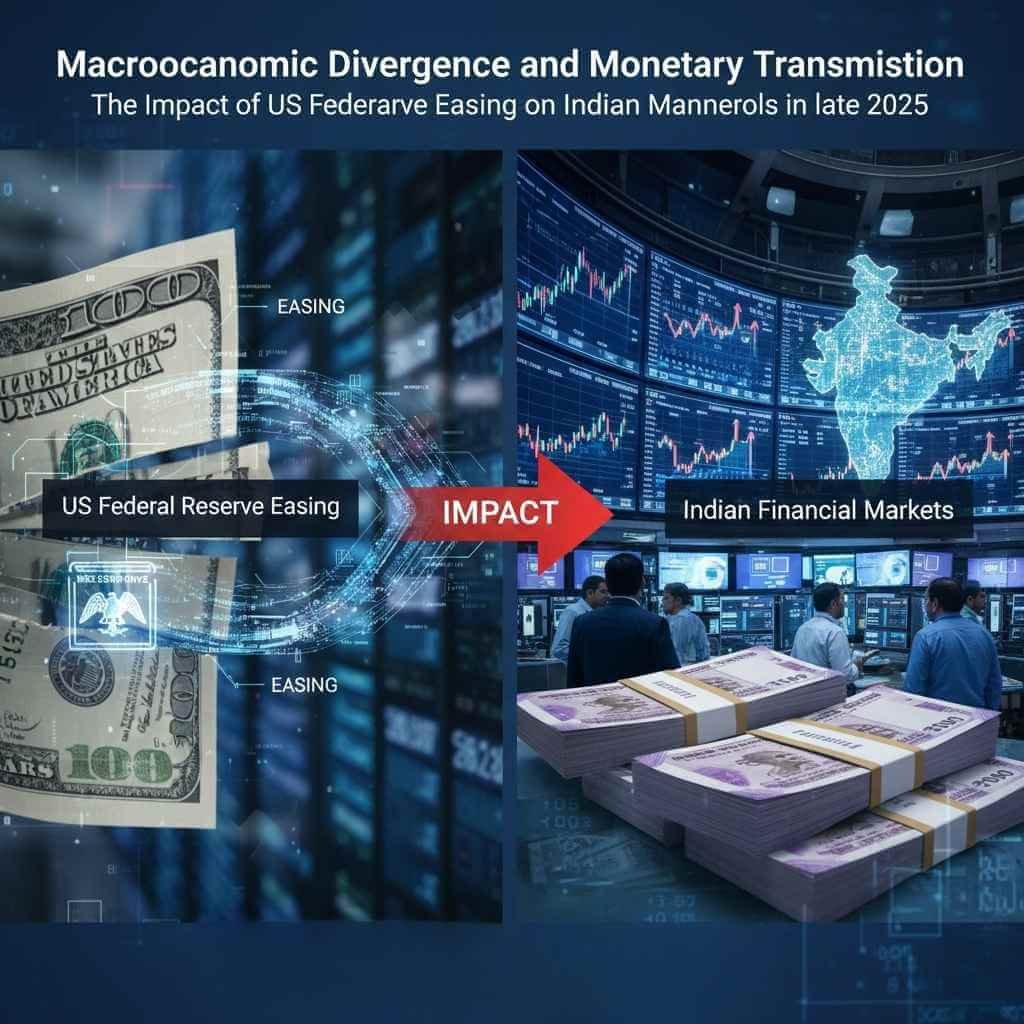
The global financial architecture in the fourth quarter of 2025 is undergoing a fundamental recalibration as the United States Federal Reserve transitions from a period of aggressive inflation containment to a sustained easing cycle. On December 10, 2025, the Federal Open Market Committee (FOMC) announced a 25-basis-point reduction in the federal funds target range, bringing it to 3.5% to 3.75%. This move represents the third consecutive cut in 2025 and a cumulative reduction of 175 basis points since the commencement of the easing cycle in September 2024. While theoretically intended to stimulate global liquidity and support emerging market assets, the transmission of this policy to India has been complicated by idiosyncratic domestic factors, persistent currency volatility, and a rising tide of protectionist trade measures.
The late 2025 period is characterized by a “decoupling” of economic momentum between the two nations. While the United States faces a cooling labor market, with unemployment edging up to 4.4% and a historic government shutdown clouding data visibility, India continues to report robust growth, with a second-quarter GDP expansion of 8.2% for the 2025-26 fiscal year. This divergence has created a unique set of challenges for the Reserve Bank of India (RBI), which has opted to synchronize its easing with the Fed by cutting the repo rate to 5.25% in December 2025, despite maintaining a neutral policy stance to safeguard the rupee.
The Federal Reserve Deceleration: Policy Implementation and Technical Shifts
The December 2025 FOMC meeting was marked by a significant lack of consensus among committee members, reflecting a growing divide regarding the trajectory of future inflation and the appropriate terminal rate for this cycle. The 9-3 split vote, which included dissents from regional Fed Presidents Austan Goolsbee and Jeffrey Schmid (who preferred a pause) and Governor Stephen Miran (who advocated for a larger 50-basis-point cut), signals that the Fed is approaching the end of its easing cycle.
Technical Reserve Management as “Technical QE”
A critical but often overlooked component of the December announcement was the decision to initiate monthly purchases of shorter-term Treasury securities—up to $40 billion per month—effective immediately. While the Fed has officially characterized these as reserve management operations intended to maintain “ample” levels of liquidity rather than quantitative easing, market analysts have interpreted this balance sheet expansion as a “technical QE”. This intervention is designed to ensure that the federal funds rate remains within its target range without the need for day-to-day discretionary interventions in money markets.
US Federal Reserve Monetary Policy Parameters
October 2025
December 2025
Delta
Federal Funds Target Range
3.75% – 4.00%
3.50% – 3.75%
-25 bps
Interest Rate on Reserve Balances (IORB)
3.90%
3.65%
-25 bps
Primary Credit Rate
4.00%
3.75%
-25 bps
Reverse Repo Offering Rate
3.75%
3.50%
-25 bps
Per-Counterparty RRP Limit
$160 Billion
$160 Billion
Unchanged
Monthly Treasury Purchase Target
N/A
$40 Billion
+$40B
This infusion of liquidity is occurring at a time when US fiscal stability is being tested by a government shutdown exceeding 35 days, the longest in the nation’s history. The lack of official government data has forced the Fed to rely on private-sector indicators, which suggest that price pressures in the goods sector remain elevated due to tariff impacts, even as services-sector inflation cools.
Dot Plot Projections and the 2026-2027 Outlook
The Federal Reserve’s Summary of Economic Projections (SEP), specifically the “dot plot,” indicates a much more hawkish stance for the coming years than many market participants had anticipated. The median projection calls for only one additional 25-basis-point cut in 2026 and one more in 2027, potentially bringing the terminal rate to a range of 3.00% to 3.25% by the end of 2027.
FOMC Economic Projections (Median)
2025 (Actual/Est)
2026 (Projected)
2027 (Projected)
Real GDP Growth
1.7%
2.3%
2.0%
Unemployment Rate
4.4%
4.4%
4.2%
Core PCE Inflation
2.8%
2.4%
2.1%
Federal Funds Rate (Year-End)
3.625%
3.375%
3.125%
The upward revision of 2026 GDP growth to 2.3% and the persistence of core PCE inflation above the 2% target until at least 2028 are the primary justifications for this cautious approach. For Indian markets, this “higher-for-longer” tilt in the US forward guidance implies that the period of easy global liquidity may be shorter and more volatile than previously expected.
Monetary Policy in India: The RBI’s Proactive Accommodation
The Reserve Bank of India’s Monetary Policy Committee (MPC) concluded its December 2025 meeting by unanimously voting to reduce the policy repo rate by 25 basis points to 5.25%. This move, chaired by Governor Sanjay Malhotra, represents a pivot toward supporting economic growth as domestic inflation reached record lows.
The Disinflationary Miracle: 0.25% October Inflation
The primary catalyst for the RBI’s easing was a stunning drop in Consumer Price Index (CPI) inflation to 0.25% in October 2025. This level of disinflation is unprecedented in the modern era of Indian monetary policy and provided the MPC with immense policy space to lower rates without risking price stability. This disinflationary trend has been supported by softening global commodity prices and stable domestic supply chains, even as external uncertainties persist.
RBI MPC Meeting Summary 2025
June
August
October
December
Policy Repo Rate
5.50%
5.50%
5.50%
5.25%
Policy Stance
Neutral
Neutral
Neutral
Neutral
GDP Growth (Actual/Proj)
~6.5%
~6.8%
~6.8%
8.2%
CPI Inflation (Actual)
4.8% (May)
3.6% (July)
0.25% (Oct)
1.2% (Est)
Despite the rate cut, the RBI maintained its “neutral” stance, signaling that it is not yet ready to commit to an accommodative path. One member of the committee, Professor Ram Singh, notably voted for a shift to an “accommodative” stance, highlighting the internal debate regarding the extent to which growth should be prioritized over a defensive currency posture.
Managing the Real Yield Differential
The combination of a 5.25% repo rate and near-zero inflation has created exceptionally high real interest rates in India. This high real yield makes Indian government securities (G-Secs) theoretically attractive to global investors looking for yield in a world of declining interest rates. However, the RBI must balance this attraction against the risk of rapid capital outflows if the interest rate differential between the US and India narrows too quickly, which could put further pressure on the already-weak rupee.
The RBI’s decision to cut rates alongside the Fed reduces the risk of “interest rate parity” shocks but leaves the currency vulnerable to global risk-off sentiment. Analysts note that the Fed’s decision to slow the pace of future cuts gives the RBI more policy leeway to focus on domestic requirements without being forced into an aggressive defense of the rupee.
Foreign Portfolio Investment (FPI) Dynamics: The December Disconnect
The relationship between US interest rates and Foreign Portfolio Investment (FPI) flows into India has historically been inverse: as US rates fall, capital typically flows into high-growth emerging markets like India. However, the first fortnight of December 2025 has seen an unusual break in this pattern, with FPIs net selling $1.96 billion in Indian equities.
Factors Driving the $1.96 Billion Sell-Off
Several factors have combined to trigger this aggressive selling during a period typically marked by lower volatility and year-end portfolio stability. The primary driver is currency risk; as the rupee breached the ₹91 per dollar mark, FPIs became increasingly concerned about the erosion of their equity returns when converted back into dollars.
Sectoral FPI Equity Flows (First Half Dec 2025)
Net Investment ($ Million)
Oil, Gas & Consumable Fuels
+331
Metals & Mining
+89
Automobile & Ancillaries
+67
Consumer Durables
+44
Capital Goods
-134
FMCG
-156
Power
-233
Healthcare
-259
Services
-357
Information Technology
-367
Financial Services (BFSI)
-718
Grand Total (FPI Equities)
-1,962
The sectoral breakdown reveals that FPIs are using the highly liquid Financial Services (BFSI) sector as their primary exit route, with $718 million in net outflows. The selling in IT and Healthcare is driven by fears of US protectionism and the impact of tariffs on Indian exports. Conversely, sectors like Oil and Gas and Metals saw modest inflows, as investors bet on a recovery in global demand and capitalized on lower valuations.
DII as the Stabilizing Force
A significant feature of the late 2025 market is the resilience of Domestic Institutional Investors (DIIs). On days of heavy FPI selling, DIIs—including mutual funds, insurance companies, and pension funds—have stepped in to provide a liquidity buffer. For example, on December 18, 2025, DIIs were net buyers of ₹2,700.36 crore, effectively countering the moderate optimism of FPIs and preventing a sharp correction in the Nifty 50 and Sensex.
This “tug-of-war” between FPIs and DIIs has kept the Indian indices in a range-bound pattern. While the Nifty 50 hovers near record highs of 26,000, its Price-to-Earnings (P/E) ratio of 22.4x remains slightly above its five-year average of 20.7x, suggesting that valuations are “fair but full,” requiring a resumption of earnings growth to justify further upside.
Currency and Trade: The Rupee’s Strategic Depreciation
The Indian rupee has faced persistent downward pressure throughout late 2025, briefly crossing the ₹91 per US dollar threshold in mid-December. While the Fed’s rate cuts typically lead to a softer dollar, the US dollar has maintained resilience as a global reserve currency during a period of intense geopolitical uncertainty and trade volatility.
RBI Intervention in Spot and NDF Markets
The Reserve Bank of India has actively intervened in the foreign exchange markets to prevent the rupee from entering a state of disorderly depreciation. In November 2024, the central bank conducted a record net sale of $20.23 billion in the spot market—the highest monthly intervention since 2000. Additionally, the RBI has become a major participant in the offshore Non-Deliverable Forward (NDF) market, running a short position in USD of nearly $65 billion to manage future expectations and reduce volatility.
This active management has resulted in the rupee-dollar volatility falling to just 1.8% in 2024-2025, the lowest level in over two decades. However, this stability has come at a cost; the market’s forward premium has dropped to 1-2%, which may encourage unhedged dollar borrowing by Indian firms, creating potential systemic risks if the currency eventually experiences a sharp adjustment.
The Export Sector’s Response to a ₹91 Rupee
The depreciation of the rupee toward ₹91/$ provides a substantial revenue boost for India’s export giants. In the Information Technology (IT) and Pharmaceutical sectors, which derive a significant portion of their revenue in dollars, every ₹1 of depreciation is estimated to boost EBITDA by over ₹200 crore on an annualized basis.
Company
Net Forex Inflow (FY25 – ₹ Crore)
Sector
Tata Consultancy Services
>120,000
IT Services
Reliance Industries
79,161
Conglomerate
Bajaj Auto
13,280
Automobile
Maruti Suzuki India
6,500
Automobile
ITC
7,019
FMCG/Agri
However, the “textbook” benefit of a weaker currency is being diluted by the high import intensity of many export sectors. For industries like electronics and chemicals, the rising cost of imported raw materials and intermediates negates much of the gain from a cheaper rupee. Only the food and agro-based export sector, which has low import intensity, emerges as a consistent winner in terms of both export volume and trade balance improvement during this depreciation cycle.
Sectoral Analysis: The Differential Impact of Global Easing
The transmission of US Fed rate cuts to the Indian equity market is non-uniform, as different sectors are sensitive to various channels such as global liquidity, the cost of capital, and commodity prices.
Banking and NBFCs: The Liquidity Tailstorm
The financial sector is the most direct beneficiary of a global easing cycle. Lower US yields typically lead to improved global liquidity, which reduces the cost of wholesale funding for Indian banks and Non-Banking Financial Companies (NBFCs). Furthermore, as the RBI follows the Fed’s lead in cutting domestic rates, credit demand in the retail and corporate segments is expected to pick up. Private sector banks and fintech NBFCs are particularly well-positioned to benefit from this “risk-on” sentiment and the resulting increase in institutional participation.
Information Technology: Balancing Easing with Protectionism
The IT services sector is caught between two opposing forces. On the one hand, a softer US dollar and Fed rate cuts typically signal a supportive environment for US corporate spending, which is the primary source of revenue for Indian IT firms. A stable or “soft landing” US economy ensures that digital transformation budgets remain intact.
On the other hand, the threat of US tariffs and the implementation of restrictive trade policies by the Trump administration create significant uncertainty. While a weaker rupee boosts short-term margins, any slowdown in the US economy or the introduction of “Buy American” mandates for software services could hurt long-term growth prospects.
Pharmaceuticals: The 100% Tariff Wall
The Indian pharmaceutical sector faces a specific and severe challenge: the implementation of a 100% tariff on branded and patented drug imports into the US, effective October 1, 2025. While generic formulations—which account for 88% of India’s $10.5 billion in pharma exports to the US—are currently exempt, the announcement has sparked massive volatility.
Pharma Sector Metric (Late 2025)
Value / Change
US Generic Formulation Exemption
88% of Export Value
Nifty Pharma Index Single-Day Fall
2.54% (Sept 26)
Sun Pharma Intraday Low
₹1,547
Quant Healthcare Fund 1-Year Return
-10.49%
Biocon Stock Decline (Post-Tariff)
-3.3%
The sector’s future outlook is clouded by an ongoing Section 232 investigation to determine if generic drug imports pose a national security risk to the US. Any expansion of the tariff scope to include generics or biosimilars would be catastrophic for the margin profiles of major Indian drugmakers, who currently rely on the US market for a significant portion of their global profitability.
Real Estate and Automobiles: Interest Rate Sensitivities
Rate-sensitive sectors like real estate and automobiles are poised for a revival as the RBI enters its own easing cycle. Lower mortgage rates and more affordable auto loans are expected to stimulate consumer demand, particularly in the urban housing and passenger vehicle segments. For automobile exporters like Bajaj Auto and Maruti Suzuki, the dual benefit of a weaker rupee and potential interest rate relief for domestic buyers creates a favorable tailwind for both the top and bottom lines.
Fixed Income and Debt Markets: Spreads and Sovereign Sentiment
The US Federal Reserve’s pivot toward easing has immediate implications for the cost of capital in India. As US Treasury yields soften, the relative attractiveness of Indian government and corporate debt increases, provided the currency risk remains managed.
G-Sec Yields and RBI Liquidity Injections
The yield on the benchmark 10-year Indian Government Security (G-Sec) held steady near 6.6% in December 2025. The market has been supported by the RBI’s record bond purchases, totaling ₹6.5 trillion for the year, which have injected necessary liquidity into the banking system to facilitate government borrowing.
However, foreign investor interest in Indian debt remains subdued as of late 2025. Factors such as steep US tariffs and the lack of a definitive US trade deal have hurt sentiment, leading to more than $1 billion in foreign bond outflows in early December.
Indian Debt Market Yield Matrix (Dec 19, 2025)
Yield (%)
1-Year Change
India 10-Year G-Sec
6.62%
-0.208%
India 2-Year G-Sec
5.85%
-0.869%
India 52-Week T-Bill
5.48%
-1.242%
India 3-Month T-Bill
5.26%
-1.230%
10-Year AAA Corporate Bond
7.00%
-0.47%
1-Year AAA Corporate Bond
6.33%
-1.29%
The Corporate Bond Milestone: ₹53.6 Trillion
India’s corporate bond market has reached a milestone, with outstanding issuances growing at a 12% annual rate to reach ₹53.6 trillion in FY25. The shift toward monetary easing by the RBI has encouraged corporations to move away from traditional bank credit and toward the bond market for long-term financing. Indian companies raised a record ₹9.9 trillion through bond issuances in FY25, surpassing the previous year’s ₹8.6 trillion.
This growth is being driven by strengthened corporate creditworthiness, with healthier profit margins and deleveraged balance sheets leading to rating upgrades. Furthermore, FPI investment in corporate bonds has jumped 11.4% to reach ₹1.21 trillion, as global investors seek a yield advantage over softening US and European rates.
The Startup Ecosystem: Weathering the $10.5 Billion Funding Winter
The Indian technology startup ecosystem remains in a period of recalibration in 2025. Despite the global trend toward lower interest rates, which typically encourages venture capital (VC) investment, Indian startups raised only $10.5 billion in 2025—a 17% drop from the $12.7 billion raised in 2024.
The Cost of Capital and Venture Supply
Historically, lower interest rates fuel VC fundraising by making private equity more attractive to Limited Partners (LPs) compared to safe-haven assets like government bonds. However, the “funding winter” of 2025 persists due to heightened investor scrutiny of burn rates and a demand for sustainable profitability rather than just top-line growth.
The impact of high US rates in 2024—reaching a 23-year high of 5.5%—had a lagging effect on Indian startups, raising the Weighted Average Cost of Capital (WACC) and making “risky” emerging market bets less appealing. As the Fed cuts rates in late 2025, there is a growing expectation of a “thaw” in 2026, as cheaper capital begins to seek higher-return opportunities in India’s maturing digital economy.
Stage-Wise Funding Trends
The 2025 funding landscape is a tale of two halves. Seed-stage funding experienced a sharp 30% decline, falling to $1.1 billion, as angel investors and early-stage funds applied more stringent due diligence. Conversely, early-stage funding (Series A and B) demonstrated resilience, increasing by 7% to reach $3.9 billion.
Startup Funding Stage (2025)
Amount ($ Billion)
YoY Change
Seed Stage
1.1
-30%
Early Stage
3.9
+7%
Late Stage
5.5
-26%
Total Ecosystem
10.5
-17%
Late-stage funding remains the most challenged segment, dropping 26% to $5.5 billion. This decline is reflected in the decrease in “large deals” (over $100 million), which fell from 19 in 2024 to just 14 in 2025. Despite this, India remains the third-highest funded tech ecosystem globally, trailing only the US and the UK.
Historical Correlation: Fed Cuts and Nifty Returns
A quantitative analysis of the last 20 years of Federal Reserve rate cycles provides critical context for predicting the Nifty 50’s performance in the current cycle. Historically, the Nifty has shown a “buy the rumor, sell the fact” pattern around first rate cuts.
The Impact of 50 bps vs 25 bps Cuts
Research highlights a nuanced response to the magnitude of Fed actions. A 50-basis-point cut has historically correlated with a median Nifty return of +1.6% in the following period. In contrast, a 25-basis-point cut, such as the one delivered in December 2025, has historically correlated with a median loss of 0.5% for the Nifty, as such small moves often signal that the Fed is either behind the curve or approaching a pause.
Historical Period
Fed Action
Nifty 6M Return (Pre-Cut)
Nifty 1Y Return (Post-Cut)
2001 (Dot-com)
50 bps Cut
-10%
-23%
2008 (GFC)
50 bps Cut
+26%
-12%
2019 (Mid-cycle)
25 bps Cut
+6%
+1%
2024-2025 (Soft Landing)
Easing Cycle
+12% (Est)
TBD
In recessionary cycles like 2001 and 2008, Fed rate cuts were unable to prevent significant equity losses as corporate earnings collapsed. However, in “non-recessionary” or “soft landing” cycles (1985, 1995, 2019), US stocks and emerging market equities have performed exceptionally well, as lower rates support valuations while economic growth remains resilient.
The “Deep Soft Landing” Hypothesis
J.P. Morgan analysts suggest that if the current cycle delivers a total of 200 basis points of easing through 2025 without a recession, it would be the deepest “soft landing” cutting cycle since the 1984-1986 period. During that historic 1984-1986 cycle, the S&P 500 returned 51% over 24 months. For India, a similar non-recessionary easing cycle would likely drive sustained FII inflows and a multi-year bull market in equities, provided domestic inflation remains anchored.
Geopolitical Risks and Macroeconomic Counter-Factors
The outlook for the Indian market is not without significant headwinds. The “Trump 2.0” administration represents a major wildcard for global monetary transmission.
The Tariff and Inflation Feedback Loop
The implementation of broad-based US tariffs (ranging from 10% to 100%) is expected to have a “one-time shift” on the US price level. Fed Chair Jerome Powell has noted that while this effect may be short-lived, the Fed must ensure it does not become an ongoing inflation problem. If tariffs lead to a re-acceleration of US inflation, the Fed could be forced to pause or even hike rates in late 2026, which would trigger a violent reversal of capital flows from India and other emerging markets.
The Yen Carry Trade and the Bank of Japan
Another emerging risk is the potential for further unwinding of the yen carry trade. As the Bank of Japan (BoJ) explores raising rates from near-zero to 0.25% or higher, the massive pool of cheap yen-denominated capital that has flowed into global equities could be recalled. A hawkish message from the BoJ could trigger more FII outflows from markets like India, regardless of the Fed’s stance, as institutional investors scramble to cover their yen liabilities.
Crude Oil and the Energy Bill
India remains highly sensitive to energy prices. Despite the Fed’s easing, any geopolitical flare-up that pushes Brent crude above $90 per barrel would widen India’s trade deficit and exert renewed pressure on the rupee. However, analysts note that even a $5 per barrel drop in oil prices (facilitated by a stronger rupee and global easing) can lower India’s CPI inflation by 15-20 basis points, creating a virtuous cycle for the RBI to cut further.
Conclusion: Navigating the Liquidity Wave
The impact of US Federal Reserve rate cuts on the Indian market in late 2025 is a complex interplay of liquidity-driven optimism and tariff-driven caution. The Fed’s 25-basis-point cut in December, accompanied by $40 billion in monthly treasury purchases, has provided a structural floor for global risk appetite. For India, this signals a return of long-term global liquidity, though the immediate FPI sell-off of 1.96billionhighlightsthemarket’ssensitivitytotherupee’sbreachof₹91/ and the threat of US trade protectionism.
The Reserve Bank of India’s decision to lower the repo rate to 5.25% demonstrates a confident proactive stance, supported by near-zero domestic inflation and robust 8.2% GDP growth. This synchronization of easing cycles reduces interest rate volatility but leaves the market exposed to the global “higher-for-longer” narrative embedded in the Fed’s dot plot.
In the medium term, the Indian equity market remains an “outperformer” among emerging peers. Sectors like banking, real estate, and consumer durables are set to benefit from lower domestic borrowing costs and improved liquidity. However, the export-oriented IT and Pharma sectors must navigate a challenging landscape of strategic currency depreciation and aggressive US tariffs. As the “funding winter” for startups begins to thaw and the corporate bond market reaches new heights of maturity, the Indian financial ecosystem is well-positioned to absorb the shifting tides of global capital, provided that the current “soft landing” in the United States does not transform into an inflationary resurgence or a recessionary downturn.